
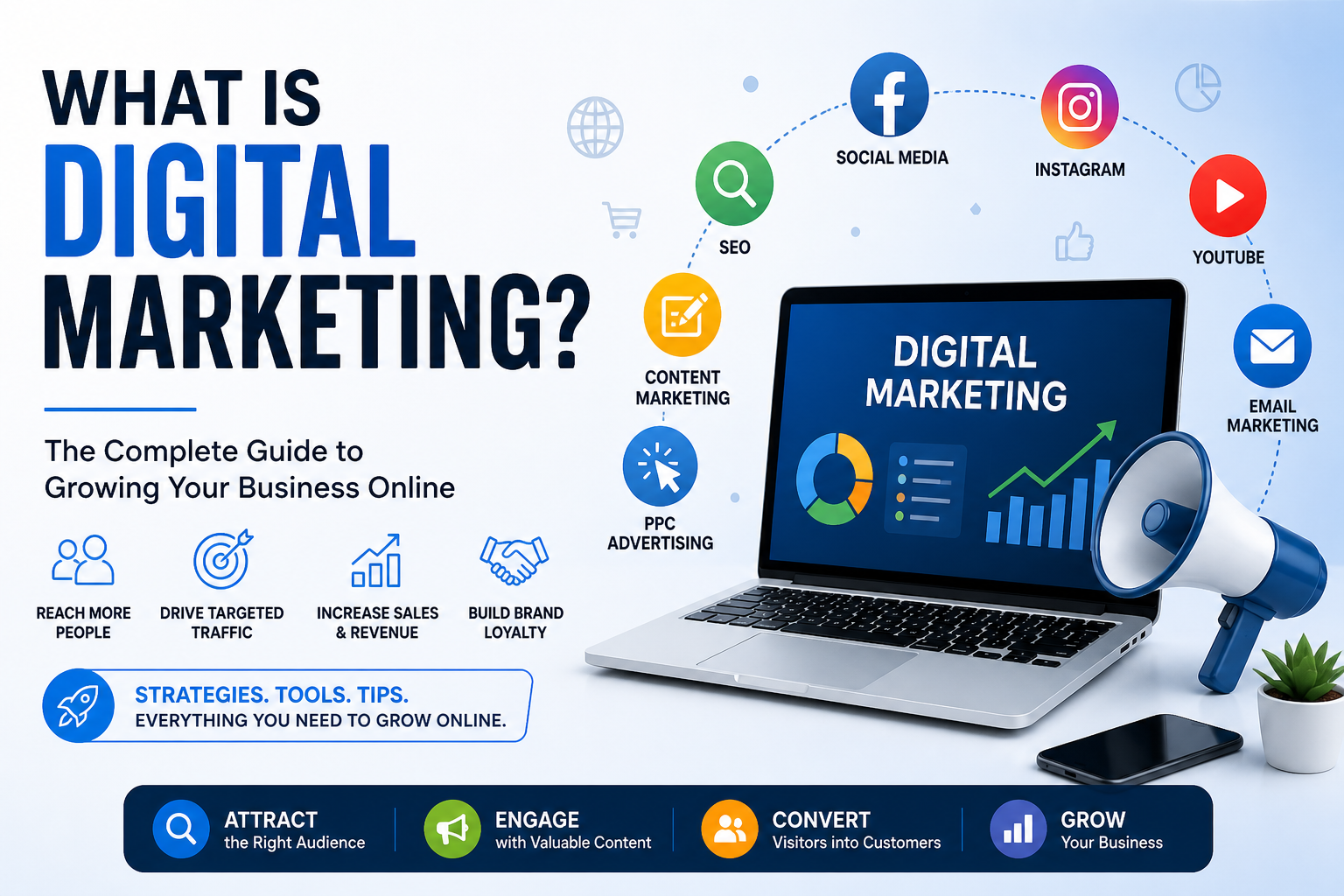
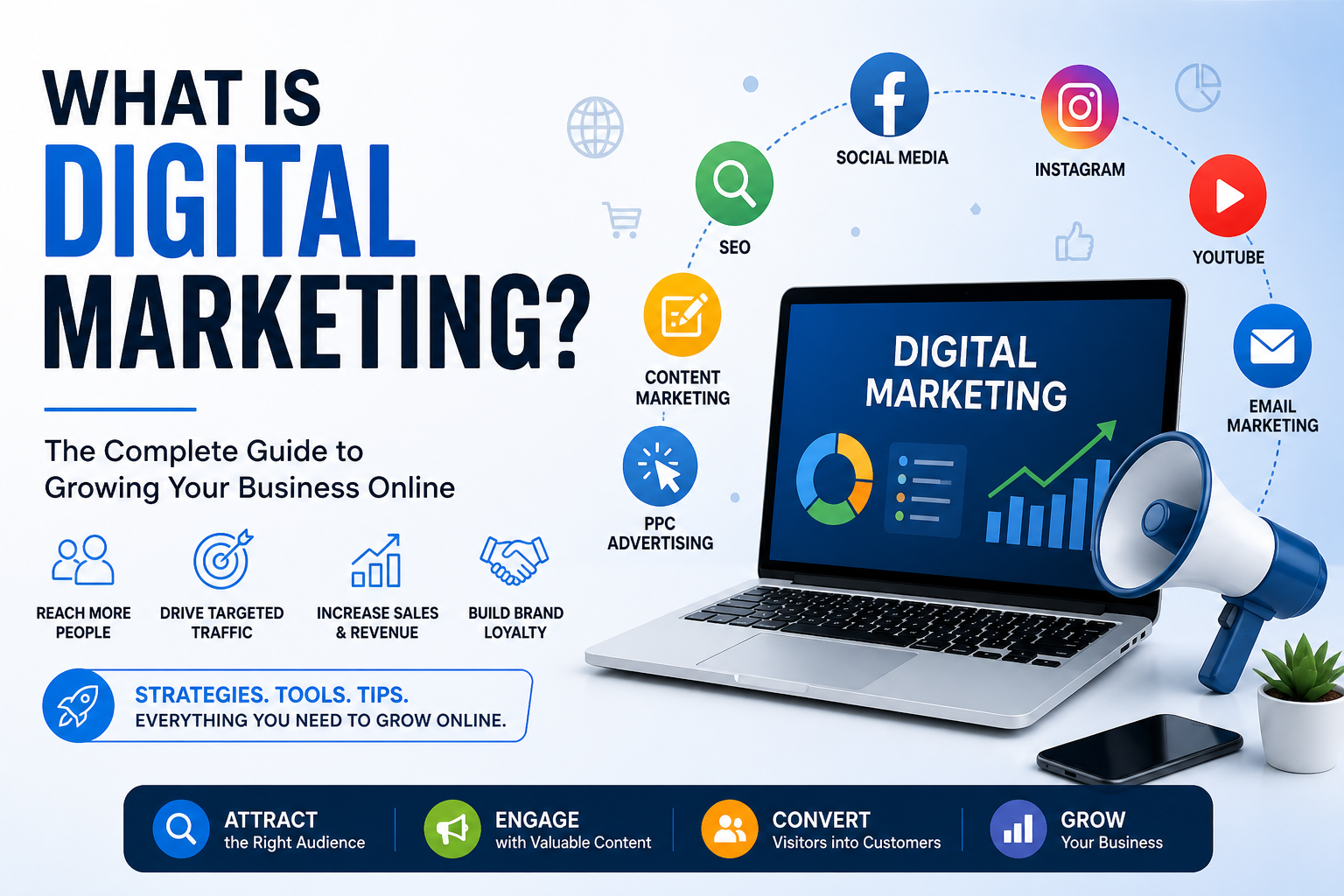
Every business owner has heard the phrase digital marketing thrown around in meetings, client calls, and industry events. But what does it actually mean — and more importantly, why does it determine whether a business thrives or disappears into the internet's noise? This guide breaks it all down in clear, practical terms, with no fluff and no jargon. What Is Digital Marketing?
Digital marketing is the practice of promoting products, services, or brands through internet-based channels and technologies. Unlike traditional advertising — billboards, newspaper ads, TV commercials — digital marketing places your business directly in front of people who are already searching for what you offer, exactly when they need it.
This covers a wide spectrum of disciplines: search engine optimisation (SEO), social media, pay-per-click (PPC) advertising, email campaigns, content marketing, video promotion, and more. What ties them together is data. Every click, impression, and conversion can be measured, which means every rupee you spend can be evaluated against real results.
Think of digital marketing not as a single tool but as an entire toolbox. The art is in knowing which tools to use, when, and in what combination to achieve your specific business goals.
Why Digital Marketing Matters More Than Ever in 2026
India alone crossed 900 million internet users in 2026. Your audience is online, comparing products on their phones, watching brand stories on Instagram, and Googling service providers before they ever call a number. If your business is not showing up in those moments, a competitor is. Here is what makes digital marketing genuinely different from older approaches:
- Reach: You can target a homemaker in Hyderabad, a startup founder in Bengaluru, or an export buyer in Dubai — from the same campaign.
- Precision: Ads can be shown only to people aged 28–45 who have expressed interest in your category, in a specific city, on a specific device.
- Accountability: Every metric — impressions, clicks, leads, sales — is trackable, making ROI conversations straightforward.
- Speed: A well-structured campaign can generate enquiries within hours of going live.
Traditional advertising still has a role, but without a digital presence, even great offline brands become invisible to the next generation of buyers. Core Channels of Digital Marketing
1. Search Engine Optimisation (SEO)
SEO is the process of improving your website so it ranks higher in Google search results for the keywords your customers type. The higher you rank, the more visitors find you — without paying for each click. A strong SEO strategy addresses technical site health, on-page content quality, and off-page authority building simultaneously.
Social Media Marketing (SMO)
Platforms like Instagram, Facebook, LinkedIn, and YouTube are where your audience spends a significant portion of their day. Social media optimisation (SMO) is about building a consistent brand voice, engaging your community, and converting followers into customers through smart content and paid promotions.
Performance Marketing (PPC & Paid Ads)
When you need leads quickly, performance marketing — including Google Ads, Meta Ads, and display campaigns — delivers targeted traffic at a controllable cost. You set the budget, define the audience, and pay only when the desired action occurs. Done right, it is the fastest route from campaign launch to booked revenue.
4. Content Writing & Marketing
Quality content educates your audience, builds trust, and supports your SEO rankings. Blog posts, landing page copy, product descriptions, and case studies all fall under this umbrella. Adzynix's content writing service focuses on producing pieces that rank, convert, and reflect your brand's authority in its niche.
5. Web Development & UX
Your website is the foundation every digital marketing effort drives traffic toward. A slow, cluttered, or confusing site destroys conversion rates regardless of how good your campaigns are. Professional web development combined with strong UI/UX design ensures visitors stay, explore, and take action.
6. Branding & Visual Identity
Before any channel works at its best, you need to know who you are as a brand — your colours, voice, values, and visual language. Consistent branding across all digital touchpoints builds trust at first glance and makes every marketing effort more memorable.
How a Digital Marketing Strategy Actually Works
Scattered activity is not a strategy. A proper digital marketing plan follows a logical sequence:
- Audience research: Who is your ideal customer, what problems do they have, and where do they spend time online?
- Goal setting: Are you building brand awareness, generating leads, or driving direct e-commerce sales? Each requires a different channel mix.
- Channel selection: Match the right tools to the goal — SEO and content for long-term visibility, PPC for immediate leads, social media for community and retargeting.
- Campaign execution: Creative assets, ad copy, landing pages, and technical setup all need to work together.
- Measurement and iteration: Review the data weekly, double down on what works, and cut what does not.
This is not a one-time project — it is an ongoing process of refinement. The businesses winning online are the ones treating digital marketing as a discipline, not a one-off expense.
Common Mistakes Businesses Make With Digital Marketing
Understanding the pitfalls is just as valuable as understanding best practices:
- Choosing the wrong channel for the goal — running brand awareness campaigns when you need immediate revenue, or vice versa.
- Neglecting the website — driving expensive traffic to a page that loads in six seconds and has no clear call-to-action.
- Inconsistent branding — using different tones, colours, and messages across platforms, which erodes trust.
- Setting and forgetting ads — campaigns need regular monitoring, A/B testing, and budget adjustments.
- Ignoring analytics — decisions made without data are guesses. Decisions made with data are strategy.
Conclusion
Digital marketing is not a buzzword — it is the engine that drives modern business growth. When its channels are combined thoughtfully and executed with expertise, the results compound: more visibility, more qualified leads, stronger brand equity, and sustainable revenue. Whether you are a startup finding your footing or an established company ready to scale, the approach stays the same: build on a solid brand identity, rank where your customers are searching, engage them on the platforms they use, and convert with a website that earns their trust. If you are looking for a partner who handles all of this under one roof — strategy, creativity, and measurable results — explore the full range of services at Adzynix, one of India's most trusted digital marketing agencies.
Frequently Asked Questions (FAQs)
Q1. What is the difference between digital marketing and traditional marketing?
Traditional marketing uses offline channels — TV, radio, print, hoardings. Digital marketing uses internet-based channels like search engines, social media, email, and websites. The key difference is measurability: digital gives you precise data on who saw your message, who clicked, and who converted.
Q2. How long does digital marketing take to show results?
It depends on the channel. Performance marketing (paid ads) can generate leads within 24–48 hours of launch. SEO is a longer-term investment — meaningful organic traffic growth typically takes 3–6 months of consistent effort. Most businesses benefit from running both simultaneously: paid for immediate results, SEO for compounding returns.
Q3. How much does digital marketing cost in India?
Costs vary widely based on business size, goals, and the channels involved. A small business might start with an SEO and social media package, while a scaling company might invest in full-funnel campaigns including PPC, content, and email automation. The better question is ROI — what return are you generating for every rupee spent?
Q4. Do I need a separate agency for SEO, social media, and ads?
Not necessarily. Working with a full-service agency is often more effective because the channels are interconnected — content feeds SEO, SEO informs ad copy, ads retarget social media visitors. Agencies like Adzynix offer all these services under one roof, ensuring your strategy is aligned rather than fragmented.
Q5. What is performance marketing and how is it different from SEO?
SEO earns traffic organically over time through content and technical optimisation. Performance marketing is paid advertising — Google Ads, Meta Ads, YouTube campaigns — where you pay for each click or action. SEO builds long-term equity; performance marketing delivers short-term, measurable volume. They work best together.
Q6. Why is branding important for digital marketing success?
Branding determines how people feel about your business in the first few seconds of encountering it. Strong branding increases ad click-through rates, improves organic search trust signals, and makes social content more shareable. Without it, even the best campaigns feel generic and forgettable.
Q7. How do I choose the right digital marketing agency?
Look for transparent reporting, a proven portfolio across multiple industries, and a team that asks about your business goals before pitching services. Check reviews, case studies, and whether they practice what they preach — do they rank well for their own keywords? Shortlist agencies that take time to understand your audience rather than offering one-size-fits-all packages.
Comments
0 CommentsNo comments yet. Be the first!